

About Masks
Here is some background on these beautiful works of art:
- History
- How the masks are made
- Care of your mask
- Authenticity
- Types of masks
- Commedia dell'Arte
- Venice Carnival
History of the Venetian Masks
The wearing of masks in theatres dates back as far as the ancient Greek festivals in honour of Dionysius, god of theatre. When the Romans conquered Southern Europe, they adapted the Grecian love of theatre and the use of masks in plays and celebrations. The Venice Carnival, (or Carnevale) which dates back to the 15th century, is still famous today, attracting tourists from all around the world to the colour and excitement of this ancient tradition.
To learn more about the History of Venetian Masks click on this link.
To learn more about the History of Venetian Masks click on this link.
How the masks are made
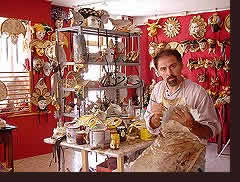 The making and wearing of Italian masks became so widespread that mask-makers have had their own official artisan status in Italy since the 15th century. Today, our artisans still make their masks completely by hand from the beginning of the process to the end.
Firstly a clay mold is created, which then has liquid plaster poured into it. When this plaster layer is completely hardened, the original clay mold is removed. The plaster (negative) mold is covered with a thin layer of Vaseline and then filled with several layers of wet paper and glue. Great care is taken to press the paper into the mold without wrinkling or creasing. After this the mold is placed on a heat source until the mask is dry and can be taken out. Then several coats of white tempera are applied and the eye holes can be cut out.
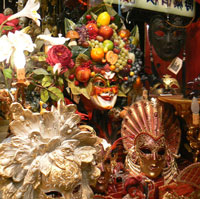 Now the mask is ready to be decorated with different kinds of materials. Masks are decorated with bright colours, gold and silver leaf, feathers, fabrics, macrame’, Swarovski crystal and leather.
These masks are sold in many parts of Venice and add to the colour and excitement of this ancient town by recalling days when they were woven into the fabric of society.
It is our pleasure to share a touch of Venetian tradition and colour with you, and we hope you like our collection of Italian masks.
back to top
Care of your Mask
Venetian masks are quite durable and easy to care for with some basic guidelines. Following these guidelines will allow you to enjoy your mask for many years:- Keep the mask away from direct sunlight, sources of heat or humidity
- To keep the mask looking in top condition, the best thing is to dust it frequently if it is on display, using a dry cloth or duster.
- Never use detergents or abrasive cleaners on the mask.
Authenticity
There are many cheap imitations out there, but ALL of our masks are imported directly from Venice in Italy and come with either a stamp of authenticity on the inside of the mask or a certificate of authenticity from the manufacturer in Venice.In addition, we have personally visited all of our mask suppliers and seen the artisans at work in their factories. We can vouch for the fact that these Venetian Masks are authentic and all hand made in Venice.
back to top
Commedia dell'Arte
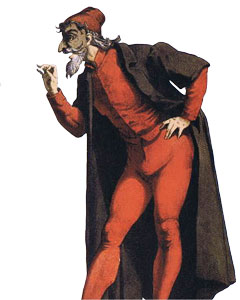 Commedia dell'Arte (translated as "the comedy of artists"), is a form of improvisational theatre that began in Italy in the 16th century and held its popularity through the 18th century. It is still performed today and we attended the performance by a troupe in Auckland, New Zealand in 2010.
In ancient times, performances were unscripted, held outside and used few props. They were free to watch and funded by donations. A troupe consisted of ten people, including eight men and two women.
Conventional plot lines were written on themes of adultery, jealousy, old age and love. Many of the basic plot elements can be traced back to Roman comedies of Plautus and Terence, some of which themselves were translations of lost Greek comedies of the fourth century BC. Performers made use of well-rehearsed jokes and stock physical gags, known as "lazzi" and "concetti", as well as, ofources, on the spot improvised and interpolated episodes and routines, called burle (jokes), usually involving a practical joke. Since the productions were improvised, dialogue and action could easily be changed to satirize local scandals, current events or regional tastes, while still using old jokes and punch lines. Characters were identified by costumes, masks and even props, such as a type of baton known as a "slapstick" (hence the modern term "slapstick comedy"). These characters included the forebears of the modern clown, namely Harlequin (English for arlecchino) and Zanni.
Click here for more information about the Commedia dell'Arte characters.
The classical, traditional plot is that the innamorati are in love and wish to be married, but one elder (vecchio) or several elders (vecchi) are stopping this from happening, leading the lovers to ask one or more zanni (eccentric servants) for help. Typically the story ends happily, with the marriage of the innamorati and forgiveness for any wrong doings. There are countless variations on this story, as well as many that diverge wholly from the structure, such as the well known story about Arlecchino becoming mysteriously pregnant, or the Punch and Judy scenario.
back to top
The Venetian Carnival
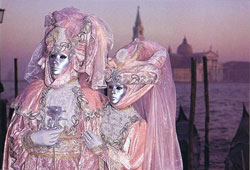 All over Italy you'll find the tradition of the Carnival, the feasting celebrating the last "hurrah" before the beginning of Lent.
However, Venice (Venezia) is certainly the carnival city 'par excellence' for this tradition. Every year for two weeks, the city is taken over by the 'il Carnevale' and shows and parties spill one after the other around the streets and canals, night and day. Thousands of people wear beautiful masks and amazing costumes and dance in the streets and piazza(s) and also ride in the traditional gondola. The climax of the event comes on the final day, the Mardi Gras, when carnival fever is at it's peak and everyone has fun and for at least one day, forgets about the troubles of everyday life. Check for details of this year's carnival here.
Click here to learn more about History of the Venice Carnival.
back to top
|
|
Contact Us
|


.jpg "ItalyMask YouTube Channel")